
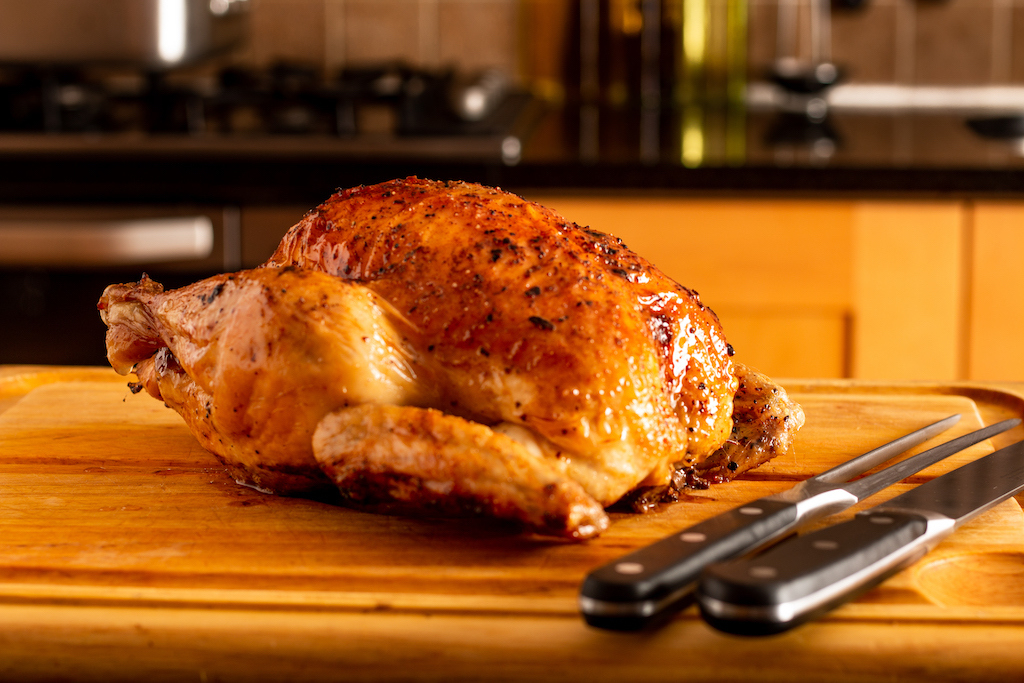
The Nosey Chef has written about some pretty ancient food milestones, but I think we might be breaking a record with the domestication of chickens.
Wild chickens still exist. These are the Gallus gallus variety that run and squawk their way around South-east Asia. It is in this region where historians believe that Gallus gallus was crossed with Gallus sonnerarii about 8,000 years ago to give us the modern Gallus gallus domesticus,
The origin of chicken domestication has become something of a pissing contest between China and the rest of Asia. China has recorded the first ever domestic chicken skeleton in Cishan, in neolithic Northern China (in the modern Wu’an province). The little bones have been dated at ~5400BC, but there is debate as to whether they are from a domesticated chook or not. It takes until 3400BC to find confirmed domesticated chicken remains in China. Scientists tend to believe that China took SE Asia’s Gallus Gallus domesticus as their own.
Once established in Asia, domesticated chickens marched West through India and the Middle East, before arriving in Europe around 2000BC.
Today, chickens are the most numerous bird on the planet. Sadly, many of them are farmed intensively in factory farms. Estimates suggest that 74% of the world’s chickens are produced this way. If I can avoid it (and it can be very hard to do this) I never buy cheap chicken. I always buy the best free-range birds I can find regardless of the cost. While obtaining a fabulous Bresse chicken is quite difficult outside of France, it is not hard to find organic, corn-fed, free-range birds in most butchers and supermarkets across Europe. I cannot speak for America, where very peculiar techniques are used for preparing chicken meat for consumers.
As far as recipes go, the one given here is legendary. This is the title recipe from Simon Hopkinson’s Roast Chicken and Other Stories. Like so many of Hopkinson’s recipes, this is pared back to everything that is needed and nothing that isn’t. Careful basting results in succulent meat and a crispy, tanned skin. It is an utterly sublime version of the Sunday roast chicken.
Roast chicken Simon Hopkinson


 (57 votes, average: 3.61 out of 5)
 Loading...
Ingredients
- 1 free-range chicken (approx 1.7kg), wishbone removed
- 100g butter, softened
- 1 garlic clove, crushed once with the flat of a knife
- 1 lemon
- 1 sprig of fresh thyme or tarragon
- Salt and freshly ground black pepper
Instructions
Preheat an oven to 240˚C
Smear the bird all over with the butter. Squeeze the lemon over the top and put the spent lemon halves, herbs and garlic in the cavity. Season liberally.
Slide the chicken into the oven and roast for 15 minutes. Remove from the oven, baste the bird with any juices, and return to the oven, turned down to 190˚C.
Roast the chicken for 1 hour, basting regularly (basting often is very important).
Once cooked, check the doneness with a meat thermometer or by skewering the thickest part off the thigh and checking that the juices run clear. Open the oven door and switch the oven off. Leave the bird in there to rest for 10 minutes before carving. Alternatively, if you need the oven to finish off another item for the table, loosely cover the chicken with foil to rest, but you will lose some crisp to steam.
Notes
The original recipe calls for 45 mins on the final cooking stage at 190˚C. Many people (including pro chefs) have commented that this is too short. I can get that timing to work, but for everyone else, I have altered the timing to add 15 mins. Thanks, Karl et al.

2 Comments
Karl Stolpstedt
23/11/2025 at 8:09 pmI have tried this recipe twice now. The total amount of time given, 60 minutes, just isn’t enough to cook a bird of this size. I’d suggest that after the initial 15 minutes of browning, one lowers the heat to 180 degrees and leave the chicken in the oven for at least 10-15 minutes longer, i.e. 80-85 minutes in total, with another 10 minutes with the lid open.
Nigel Eastmond
24/11/2025 at 5:20 pmKarl, You are not the first person to say this. Even chefs have said that this is not long enough. I think, in practice, I go longer for convenience. It is time to update this … doing it now.