
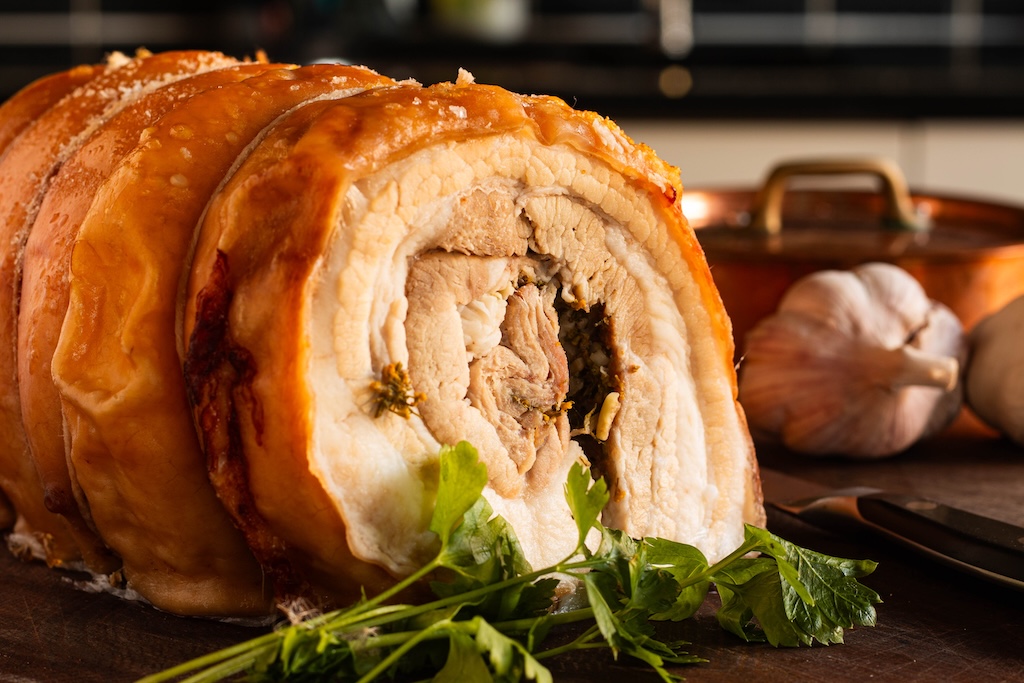
Given that porchetta is Italian and the original involves skewering an entire piglet on a stick, it is not surprising that its origins are Roman. The Romans loved to skewer stuff – pigs, lambs, chickens, Jesus Christ. All of them were subject to a poke with a stick.
Various parts of Italy lay claim to inventing porchetta, but its ancient, 2,000-year-old origins are in no doubt. The strongest regional claimant is Lazio, in the city of Arricia, where porchetta is celebrated wth its own 2-day festival every September. The event features music, dance, traditional costumes and many, many sandwiches made with porchetta and ciabatta.
To make porchetta at home, we need to ignore the idea of the whole pig and go for rolled belly. The basic premise is to lay the joint flat, sprinkle in quite a lot of herbs, roll it up and cook it. However, there seem to be many crimes committed in the name of porchetta, and the chief one is skipping the single, essential herb – fennel pollen.
Most food writers creating recipes of convenience will tell you to pack your porchetta with rosemary and thyme. But to get it right, you really ought to be using rosemary and fennel pollen. Fennel pollen is not something many people have hanging about, but you can buy it from Amazon in a 15g quantity for the crazy price of £16, which is nearly as much as a 2.5kg joint of pork belly.
However, fennel grows easily in almost any northern European garden, including my own in Derbyshire, UK. In the month of July, the fennel stands tall and is capped wth bright, yellow flowers. All you have to do is harvest those flowers and chop them up to get the herb you need.
Porchetta has a kissing cousin in the Filipino lechon. We have a recipe for that too.
Here follows our recipe for porchetta using fresh garden herbs gathered in the hottest summer on record (2026).
Porchetta
 (No Ratings Yet)
 Loading...
Ingredients
- 2.5kg pork belly, boned (ensure the skin is bone dry, so get it from a proper butcher, or towel it dry and leave it uncovered overnight in the fridge)
- 2 tsp sea salt
- 2 cloves of garlic, chopped
- 2 tbsp fresh rosemary, chopped (or 1 tbsp dried rosemary)
- 2 tbsp fennel flowers, chopped (or use commercially bought fennel pollen)
- Olive oil
- Some more salt (rock salt in a grinder, ideally)
Instructions
Set an oven to 220˚C.
Lay the pork out flat, skin side down. Spread over with the sea salt and the garlic and rub in. Spread the rosemary and fennel evenly over the meat.
Roll the belly up and tie it at intervals all the way down in to a secure roll.
Oil the skin with a minimal amount of olive oil. Too much will prevent the blistering needed to get crackling. Liberally salt it from the grinder seconds before it goes in the oven.
Roast at 220˚C for about 30 mins. The top will be hard to tap with the back of a knife, but not burnt.
Turn the oven down to 160˚C and cook for a further hour and 30 mins (approx.) until the internal temperature reaches 70˚C (internal temperature is more critical than the timing, so use a probe).
Rest uncovered for 15 mins. Carve and serve.
Notes
The classic way to serve porchetta is in a sandwich made with ciabatta. You can also cook it as a main dish protein. We did this and added a sauce of pan juices, cooked off flour, chicken stock, lemon, oregano, parsley and tarragon. If you pour off some of the fat to waste, and use the remainder, deglazing with stock and emulsifying with lemon juice, you can get a great sauce to go with your porchetta.

No Comments